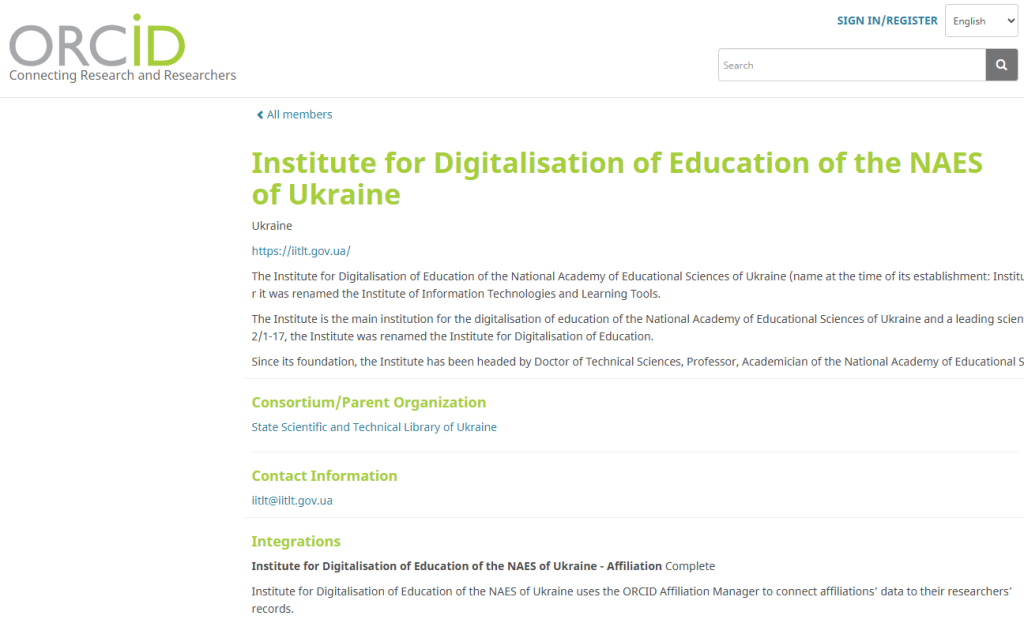
In July 2026, the Institute for Digitalisation of Education of the NAES of Ukraine joined the National ORCID Consortium in Ukraine. Participation in the consortium opens up opportunities for the exchange of reliable scientific data and the integration of the institution’s information systems with international research infrastructure.
In September 2026, researchers at the Institute confirmed their affiliation with the institution—that is, details regarding their place of work—in their ORCID profiles. This is an important step toward the consistent representation of our scientific community in the digital environment.
What does this offer the researcher and the institute?
An ORCID iD is a unique researcher identifier that helps link the researcher to their scholarly works and other research outputs. Institution-verified affiliation information can be used in systems integrated with ORCID, such as when submitting manuscripts and grant applications.
Membership opens up the following practical opportunities for the Institute:
- Confirmation of staff affiliations (adding and updating information about employment at the Institute) via Affiliation Manager with their consent, without the need to develop a custom software integration.
- It is more reliable to link researchers and their scientific results to an institution.
- Integration of ORCID with institutional repositories and other information systems for metadata reuse.
- In the future, it may be possible to use harmonized researcher data to improve the tracking and analysis of research activities (the goals of the Ukrainian consortium).
The Ukrainian and global ORCID community
The activities of the Ukrainian consortium are coordinated by the State Scientific and Technical Library of Ukraine with the support of the Ministry of Education and Science of Ukraine; its establishment was officially announced in the autumn of 2022. Initially, the consortium comprised 17 institutions.
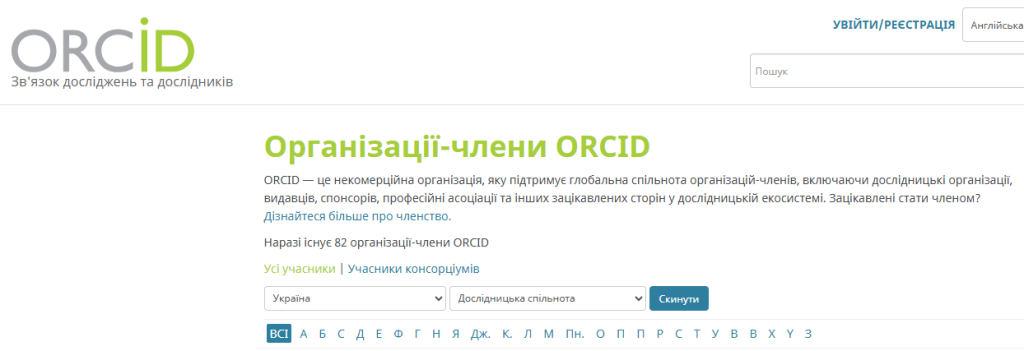
As of October 12, 2026, the official list of the Ukrainian ORCID consortium includes 82 members, including the State Scientific and Technical Library of Ukraine and the Institute for Digitalisation of Education of the National Academy of Educational Sciences of Ukraine. As of that date, the global ORCID registry comprises 1,560 member organizations.
We anticipate that leveraging ORCID’s capabilities will enhance the visibility of the Institute’s research, facilitate the exchange of scientific information, and foster international collaboration. For us, this represents another practical step toward open science and the effective global representation of Ukrainian scientific achievements.